Golden Mind Deep Transformation Program Client Practice Tools
Subconscious Reprogramming Practice
This short daily practice helps reinforce the work we do during your sessions and allows your subconscious mind to integrate new patterns.
Step 1 – Relax
Find a quiet place where you can sit comfortably. Take a few slow breaths and allow your body to relax.
Step 2 – Bring Awareness
Think about the new state or feeling you want to strengthen in your life (confidence, calm, clarity, etc.).
Step 3 – Visualization
Imagine yourself already living with this new state. Notice how you think, feel, and respond in this new version of yourself.
Step 4 – Reinforcement
Repeat a simple supportive thought to yourself such as:
I allow myself to move forward with clarity and confidence.
Practice this for 3–5 minutes each day, especially before sleep or shortly after waking up.

Grounding Breath Practice
This grounding breath practice can help regulate your nervous system and bring your mind back to a calm and balanced state. It can be used daily, especially during moments of stress, frustration, or emotional overwhelm.
When to use this practice:
• During a stressful or overwhelming moment
• When you feel anger or frustration rising
• At the end of a demanding workday
• Before sleep
• Before or after your transformation sessions
How to Practice
Step 1 – Pause
Stop what you are doing and take a moment to become aware of your breathing. Sit comfortably with your feet on the ground or lie down in a relaxed position.
Step 2 – Slow Inhale
Inhale slowly through your nose for 4 seconds. Allow the breath to move deeply into your abdomen rather than your chest.
Step 3 – Gentle Hold
Hold the breath softly for 2 seconds without tension.
Step 4 – Slow Exhale
Exhale slowly through your mouth for 6 seconds. Imagine releasing tension, stress, or frustration with each exhale.
Step 5 – Continue the Cycle
Repeat this breathing cycle for 3–5 minutes.
Breathing Pattern
Inhale: 4 seconds
Hold: 2 seconds
Exhale: 6 seconds
The longer exhale signals safety to the nervous system and helps the body move out of a stress response.
Helpful Tips
• Allow your shoulders to relax while breathing
• Place one hand on your chest and one on your abdomen if it helps you stay present
• Focus your attention on the sensation of the breath moving in and out of the body
• If your mind wanders, gently bring your attention back to the breathing rhythm
After the Practice
Take a moment to notice how your body feels. Many people experience a sense of calm, clarity, or emotional release after just a few minutes of slow breathing.
Practicing this exercise regularly can help train the nervous system to return to a calm state more easily during challenging moments.

Future Self Alignment Practice
This practice helps align your mind with the version of yourself that has already moved beyond the patterns or challenges you are working to change.
It is best practiced in a quiet space where you can relax for a few minutes.
Step 1 – Relax
Sit comfortably and take a few slow breaths. Allow your body to relax and your attention to settle.
Step 2 – Imagine Your Future Self
Imagine a version of yourself in the near future who has already transformed the issue you are working on.
Notice how this version of you:
• thinks
• moves
• responds to situations
• carries themselves in daily life
Step 3 – Observe the Difference
Ask yourself gently:
What is different about this version of me?
Notice the posture, breathing, confidence, or calmness this version of you carries.
Step 4 – Step Into That State
Now imagine stepping into that future version of yourself.
Feel what it is like to think, breathe, and move from that place.
Allow your body to experience this new state for a few moments.
Step 5 – Return With Awareness
Take a slow breath and gently bring your awareness back to the present moment.
Carry a small part of that future state with you into your day.
Emotional Tapping Reset
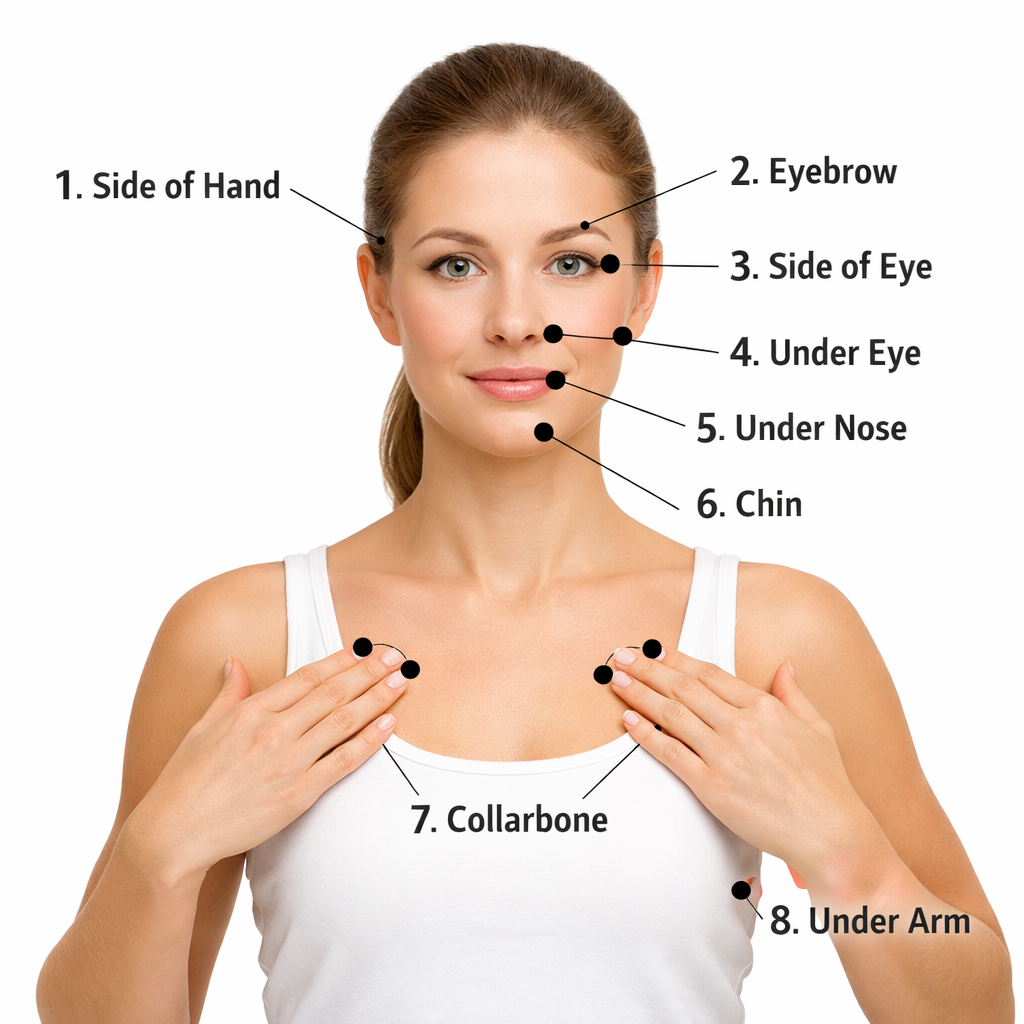
This tapping practice can help calm the nervous system and release emotional tension such as stress, frustration, anxiety, or anger.
It works by gently stimulating specific points on the body while bringing awareness to the emotional experience.
Step 1 – Identify the Feeling
Pause and notice what you are feeling in the moment (stress, anger, frustration, etc.). You do not need to change the feeling yet, just acknowledge it.
Step 2 – Begin Tapping
Using two or three fingers, gently tap the following points while breathing slowly.
Tap each point for about 5–10 seconds.
1. Side of the hand (karate chop point)
2. Eyebrow (inner edge of the eyebrow)
3. Side of the eye
4. Under the eye
5. Under the nose
6. Chin
7. Collarbone area
8. Under the arm
Step 3 – Gentle Acknowledgment
While tapping, you may silently say a simple phrase such as:
Even though I feel this tension, I allow my body to relax.
Step 4 – Breathe and Notice
After tapping the points once or twice, take a slow breath and notice any change in how your body or emotions feel.
Step 5 – Repeat if Needed
You can repeat the tapping sequence for a few minutes until your body begins to feel calmer and more balanced.